On this page
GEO and AEO (generative engine optimization and answer engine optimization) are two names for the same goal: making your content easy for AI systems to quote. Being crawled is the precondition. Being cited depends on whether your page contains clear, self-contained answers from a source that looks accountable.
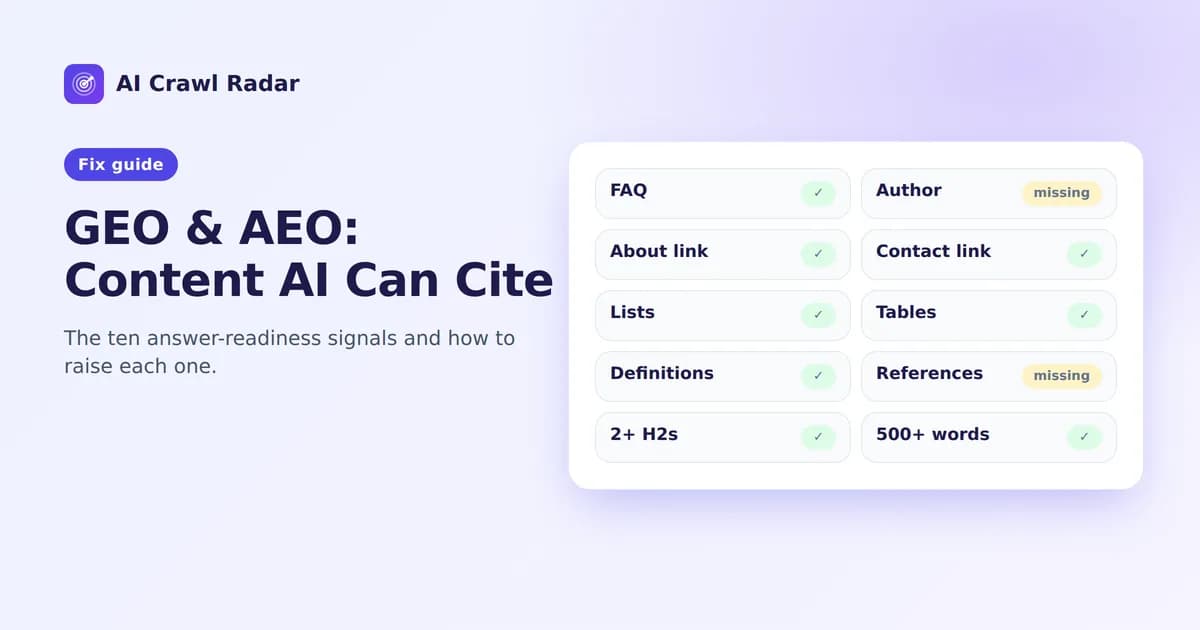
GEO/AEO Readiness is worth 5 of the 100 points in an AI Crawl Radar audit. It is scored from ten signals on the audited page. None of them guarantees a citation, and no tool can promise that, but together they describe content that is structurally easy to extract and attribute.
The ten signals
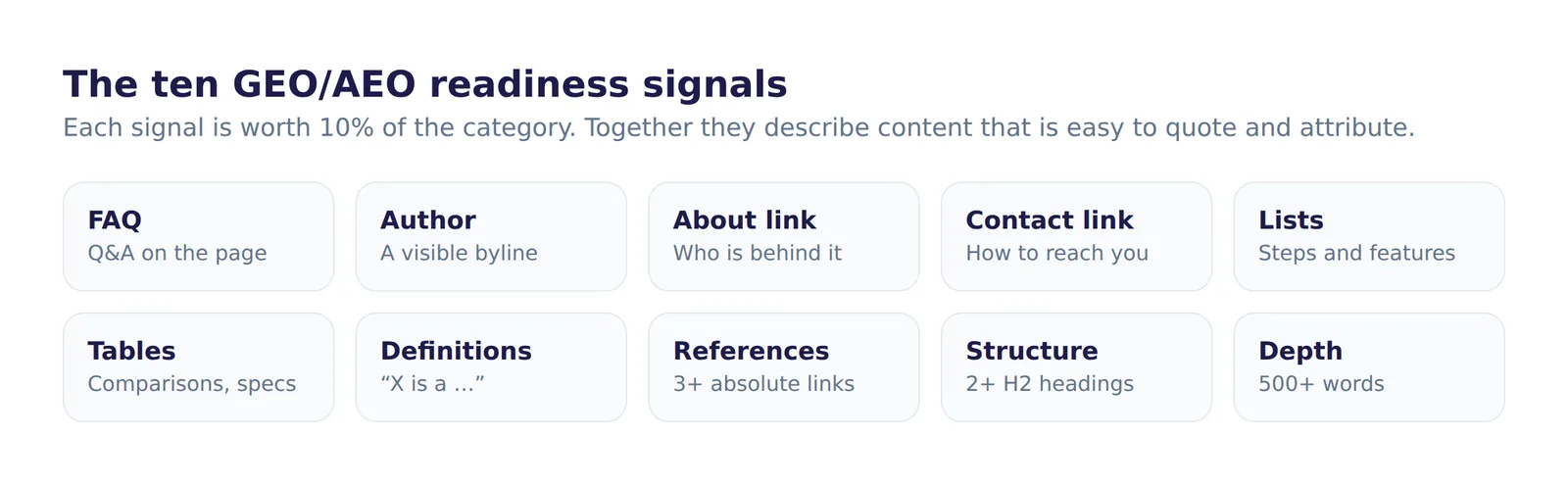
Each signal is worth a tenth of the category. The report shows the result as an answer-readiness percentage.
| Signal | What the audit looks for |
|---|---|
| FAQ | The text "FAQ" or "Frequently asked" anywhere in the page's HTML, or FAQPage markup |
| Author information | A visible byline such as "By Jane Smith", a rel="author" link, or Person markup |
| About link | A link to an About page |
| Contact link | A link to a Contact page |
| Lists | At least one bulleted or numbered list |
| Tables | At least one HTML table |
| Definitions | Defining phrases such as "is a", "refers to", "means" or "defined as" |
| References | More than two absolute (https://…) links |
| Section structure | Two or more H2 headings |
| Depth | 500 or more words |
GEO vs SEO: what changes?
GEO builds on SEO rather than replacing it. Pages still have to be crawlable and indexable; GEO adds self-contained answers and clear signals of who stands behind them.
Why these signals matter
AI answers are often built from short passages. A passage is easy to lift when it makes sense on its own: a definition, a list of steps, a row in a comparison table, a question with its answer. Accountability signals (who wrote this, who stands behind it, how to reach them) help a system decide whether the source is worth citing. The ten checks are simple, observable stand-ins for those two ideas: extractability and attribution.
How to raise each signal
Add a real FAQ
Collect the questions customers actually ask (from support tickets, sales calls or search queries) and answer each in two to four sentences that stand on their own. Put them under a visible "Frequently asked questions" heading. Add FAQPage structured data only for questions and answers that are visible on the page. See structured data for AI.
Show who wrote it
Add a byline with a real name to articles and guides, ideally linking to an author page that explains their experience. For company pages, make sure the About page names the people behind the business. Do not invent authors or credentials. A fictional expert is worse than an honest company byline.
Link to About and Contact
Most sites already do this in the header or footer, so check that the links are present in the HTML of the audited page. If your navigation is rendered only by JavaScript, crawlers may not see it. Our content accessibility guide explains why.
Use lists and tables for list-shaped and table-shaped information
Steps, requirements and feature sets belong in lists. Comparisons, specifications and pricing belong in real HTML tables. A table drawn with images or div grids is invisible as a table to a crawler.
Define your key terms
Open important sections with a plain definition: "An llms.txt file is a Markdown file at the root of a site that…". A definition makes sense on its own, which makes it easy to quote, and writing one forces clarity.
Cite your sources
Link to the primary sources behind your claims: documentation, standards, studies, official announcements. The research that coined the term GEO (Aggarwal et al., 2023) found that adding citations and statistics made content more visible in generative engine responses. More than two external references on the page passes the check, and it is good practice anyway.
Structure with H2 headings
Break the page into sections with descriptive H2 headings, phrased the way people ask, such as "How much does it cost?" or "How do I install it?". Each section should answer its heading directly in its first sentence or two.
Say enough to be useful
500 words is the threshold for the depth signal. It is not a target to pad to. It reflects that a page answering a real question usually needs that much room. If a page cannot reach it honestly, consider merging it with a related page.
Write for people first. Every signal above also makes a page better for human readers. Adding an empty "FAQ" heading or a table for its own sake may move a number, but it will not get you cited.
Beyond the homepage
The audit scores the page you entered. Content pages (guides, product pages, documentation) are often where citations come from, so audit those too, not only your homepage. On paid plans, background multi-page scans and page-level GEO/AEO recommendations cover more of your site at once; see pricing. On WordPress, the AI Visibility Optimizer plugin gives per-post suggestions while you edit, such as a summary near the top, specific numbers, plain definitions and lists.
Verify
Re-run the AI visibility audit on the page you improved. The GEO/AEO Readiness score in the breakdown rises by 10% for each signal you add. On paid plans, the GEO/AEO recommendations list shows which gaps remain.
Related guides
Frequently asked questions
6 questions people ask about this topic
What is the difference between GEO and AEO?
Is GEO different from SEO?
How do I get my site cited by ChatGPT?
What kind of content gets cited most?
Do FAQs help AI cite a page?
Can a tool guarantee my site gets cited by AI?
See how AI crawlers read your site
Run a free AI visibility audit: a 0–100 score and a fix for every lost point.
Analyze my website